
Observe
Sample the foreground application and input-idle state every two seconds through platform-specific tracking adapters.
A private behavioral mirror that compares what I meant to do with what I actually did—then intervenes before an unfocused moment becomes a lost day.
Most habit trackers depend on manual check-ins after the behavior has already happened. They can record a completed task, but they cannot see the quiet drift between opening the laptop and losing an hour to idle time, fragmented attention, or an application that was never part of the plan.
Drixx began as a personal answer to that gap. Instead of asking for another retrospective log, it observes foreground activity locally, relates that activity to the day’s intentions, and makes avoidance visible while there is still time to change direction.
The system turns operating-system events into understandable feedback without sending personal history to a remote service.
Sample the foreground application and input-idle state every two seconds through platform-specific tracking adapters.
Resolve each interval as deep work, goal-aligned, neutral, distracting, or idle using persistent app categories.
Map applications to one of three daily intentions so time spent in the right tool counts toward the work that matters.
Aggregate active time, distraction, idle time, and context switching into daily summaries and a bounded focus score.
Notify at configurable thresholds with grounded prompts designed to restore agency rather than manufacture guilt.
A browser can be research, communication, or distraction. Drixx does not pretend that process names carry universal meaning. The activity view exposes every tracked application, its accumulated time, and its current category so the model can be corrected in place.
Goal mappings sit above general categories. When an application serves an active intention, its time can become goal-aligned without rewriting the user’s permanent classification.
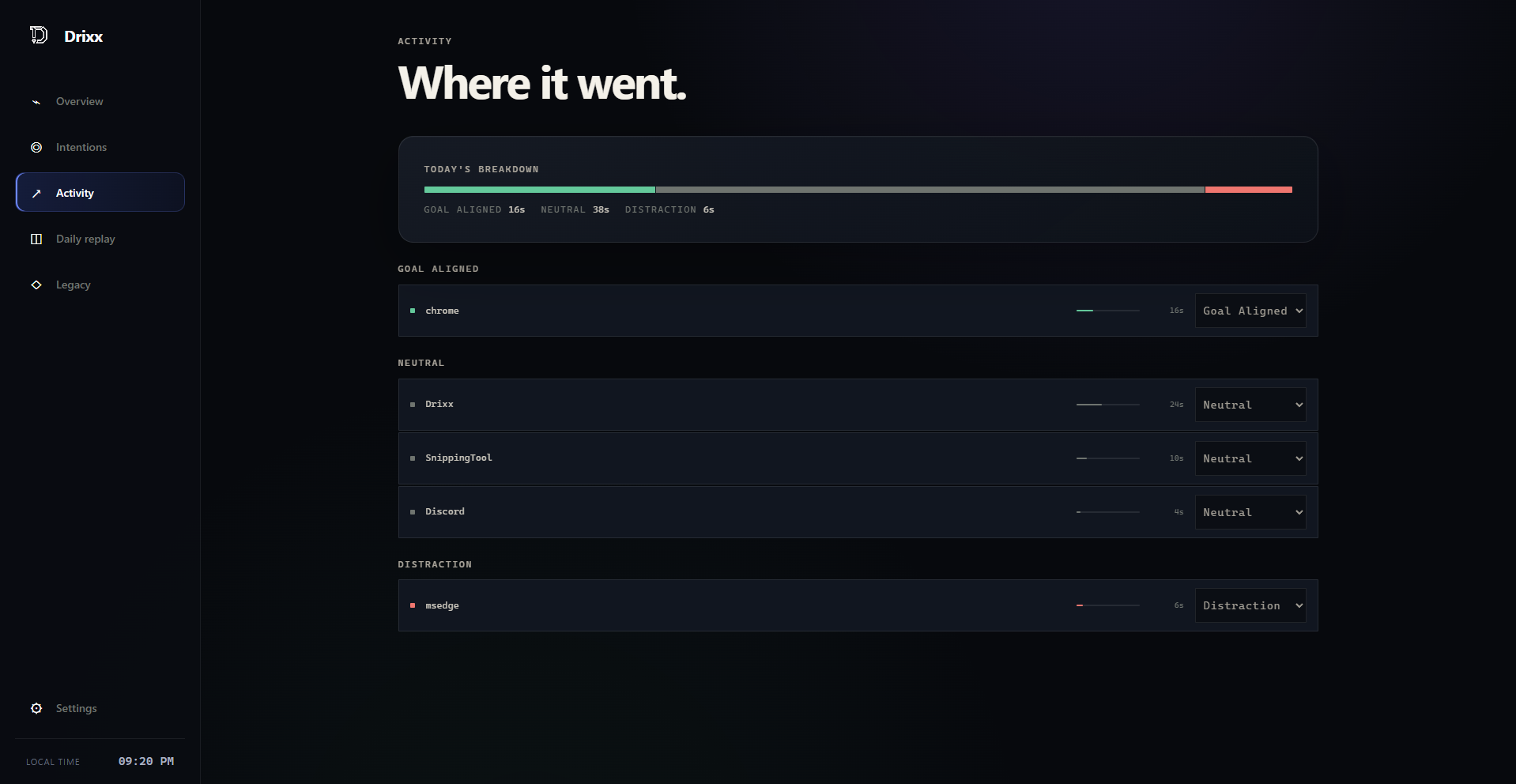
The activity breakdown makes classification visible and reversible instead of hiding judgment inside an opaque score.
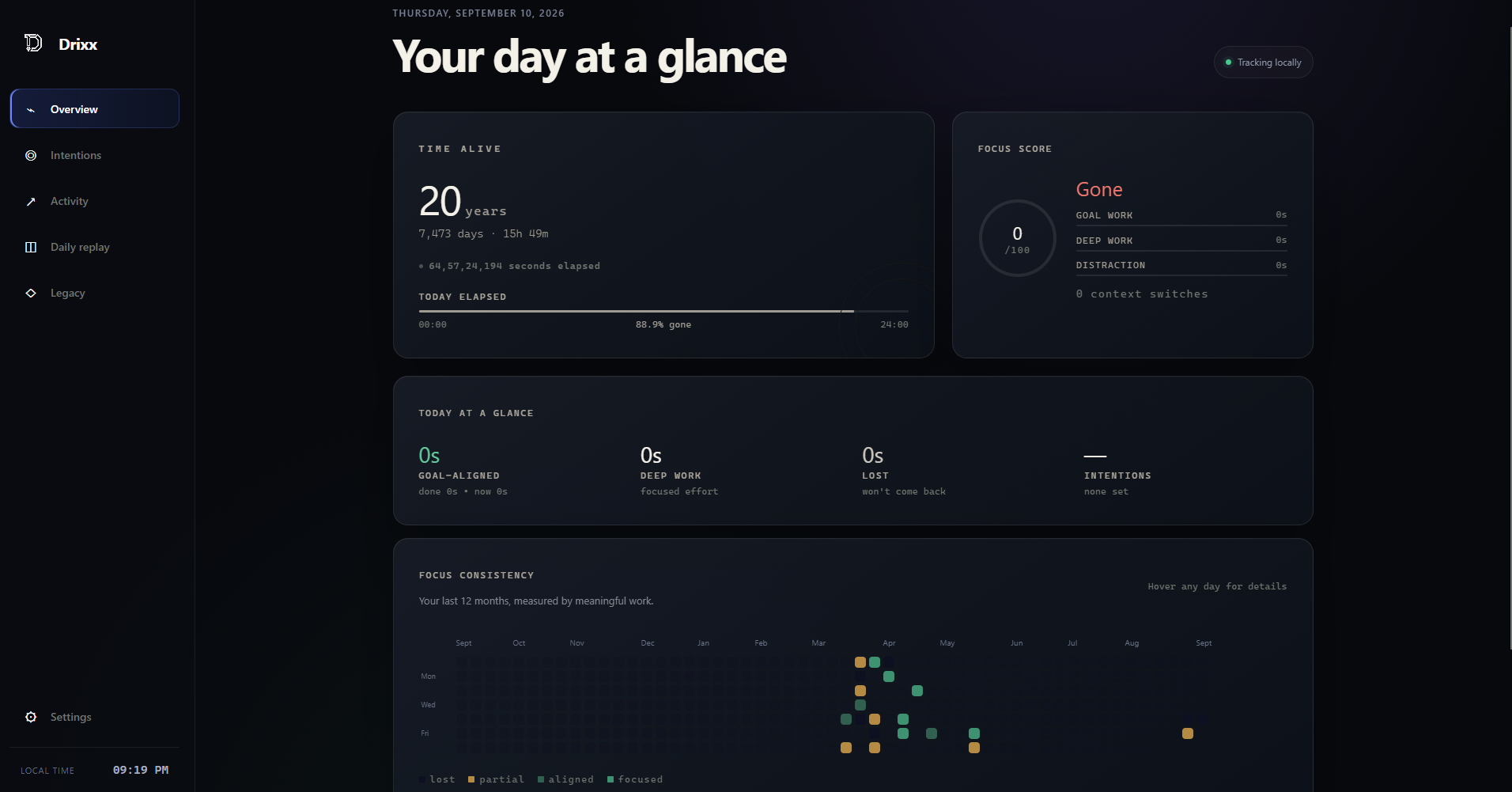
Life context, today’s totals, focus score, intentions, and a full-year consistency heatmap.
Three deliberate priorities with completion state and application mappings.
Application-level time, category editing, and a proportional view of the day.
A chronological reconstruction of where attention moved throughout a selected day.
A quieter surface for recording the principle or life direction behind the daily system.
Notification timing, idle and distraction thresholds, app categories, and custom alert audio.
SQLite stores intentions, window activity, categories, mappings, and summaries on the user’s own machine. There is no account or telemetry layer.
Two-second activity records feed daily aggregates. Goal-aligned work remains part of deep work without being counted twice in the focus formula.
User-facing dates are built in local time rather than UTC, preventing late-evening activity from slipping into the wrong heatmap day.
Windows uses native APIs. Linux supports X11 tooling while documenting the privacy restrictions that prevent generic foreground inspection on pure Wayland.
Alerts fire at the configured threshold, avoid startup suppression, and wait for a genuinely new idle period before interrupting again.
Drixx became a complete desktop product spanning native activity tracking, a local behavioral data model, configurable interventions, cross-platform packaging, and an interface built to keep difficult information readable.